
This post is one part of Soha Aftab’s work for the International Student Undergraduate Research Award. Stay tuned for more posts and event announcements!
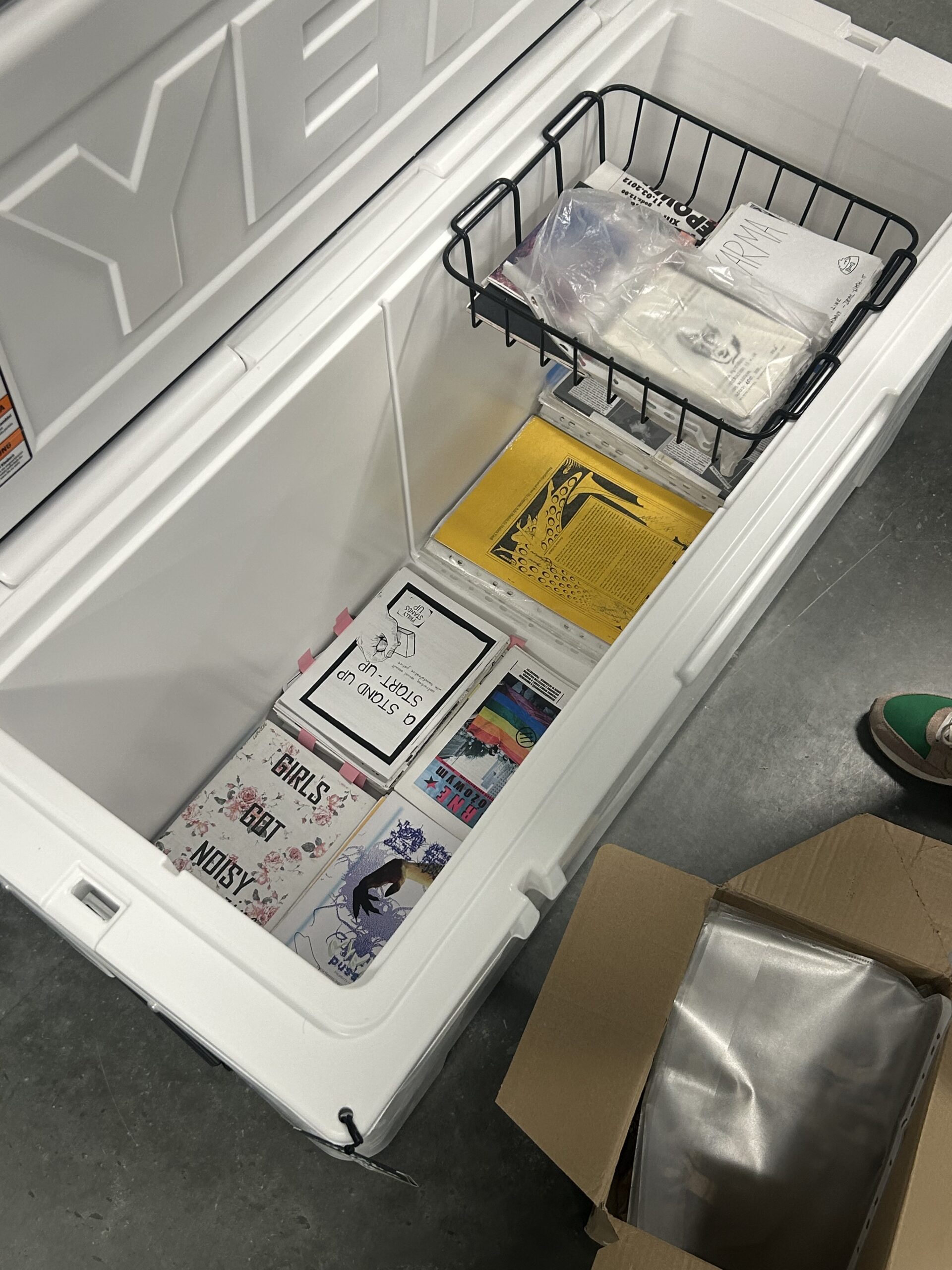
On May 13th, a medium-sized brown box filled with zines, (“individualized booklets [that are] self-produced and anti-corporate”) (Piepmeier 2), was received by a UPS facility in Warsaw, Poland. The box was packaged carefully, wrapped in layers of clear tape to prevent any wear and tear on its journey which took less than a week to arrive at its destination. The package migrated across several national and city boundaries before arriving in Kelowna and was delivered into the hands of the team at ReMedia Infrastructure at UBC Okanagan.
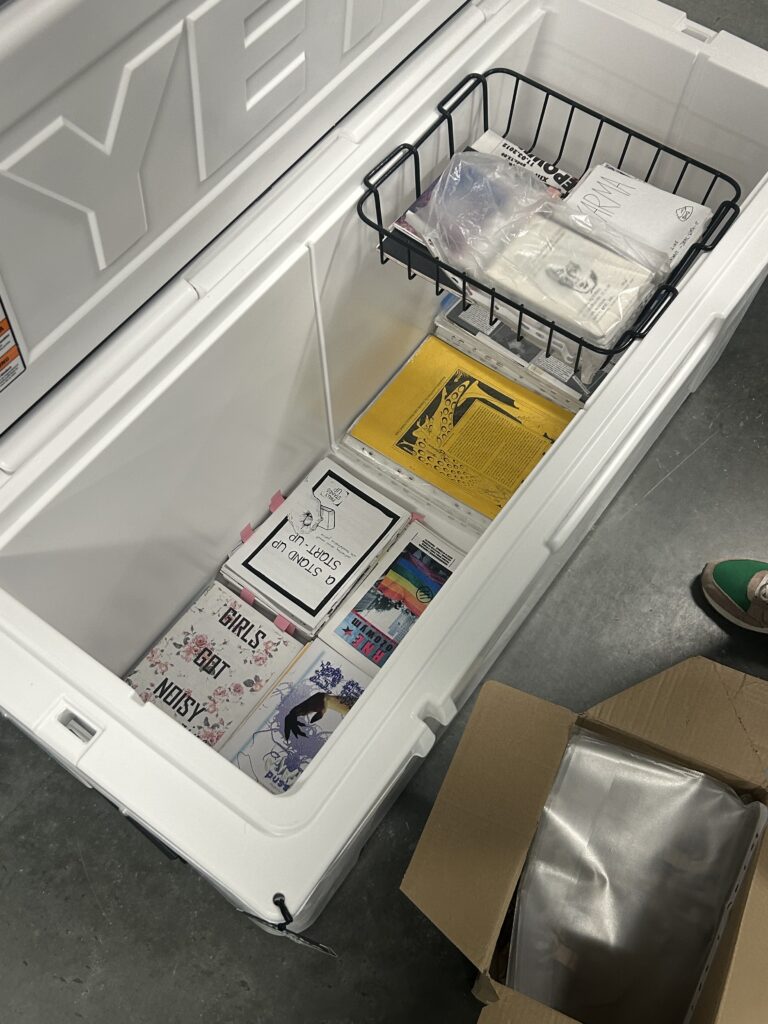
In mapping the geographical journey of this package, I am struck by the novelty of its migration. This package contained a collection of queer and (anarcha)feminist zines produced in Poland. These materials act as archival evidence of the changes that occurred in Poland after the end of the Soviet Union, and the reaction to these changes from women and LGBTQIA+ communities. They were gathered and collected by Dr Barbara Dynda in Poland as part of her doctoral research and activism. She is interested in the record of feminist and queer discourses in Poland that the zines contain. In her work, Dr Dynda examines reproductive rights, lesbian culture in Poland, and (anarcha)feminist and queer politics as they appear in the zines.
It is valuable to examine how these zines were produced and disseminated with Poland. A major context for the creation of these zines was the rapid rollout of conservative policies, post 1989. Heavily influenced by the Catholic Church, which assumed moral authority in response to the Soviet-era communist government, post-socialist Poland dismantled policies related to gender equality and workplace protections for women. It also attacked reproductive rights by initiating a new law that heavily restricted abortions (Stasiowska 225). This conservative legacy has continued well into the 21st century, with a total ban on abortions in 2020, leading to mass protests.
The Prawo I Sprawiedliwość (PiS) party, which continues to dominate politically, frames its conservative ideology as “a cultural counter revolution against liberalism and Western individualism” (Stasiowska 226). This ideology emerged from Poland’s collective memory of Soviet control, and centuries of foreign domination prior to that. As a result of this trauma, there was a desire for Poland self-governance, and thereby, a return to tradition. It was this ideation that put added focus on women’s roles as mothers, carers, and moral backbone of the nation (Gwiazda 5).
As Judith Butler describes in their book Who’s Afraid of Gender, this “strengthening” of Poland’s national identity is directly connected to the backsliding of women’s and LBGTQIA+ rights. According to Butler, fear is purposefully weaponized by conservative political forces to vilify how gender is perceived by the public. Therefore, gender is purposefully defined in relation to immorality to denigrate its value in society. In this context, gender is “portrayed as a set of ideas that are in opposition to science or religion, or both, or as a danger to civilization, a denial of nature, an attack on masculinity or the effacement of the differences between the sexes” (10). Butler points out that anxieties about shifts in the cultural understandings of gender and sexuality are inextricable from the rise of far-right political projects and authoritarian regimes, in Poland and globally.
These circumstances demonstrate the importance of archiving the lives and experiences of queer and feminist groups in Poland who have lived through and continue to survive these circumstances. Individuals and collectives have created pockets of community for themselves through making and sharing zines. This has led to a special archive that displays the political, social and cultural dimensions of the lives and beliefs of (anarcha)feminist and queer activists.
However, in the context of this tense political climate and the ephemerality of these zines, which are highly critical of conservative political projects, these zines become vulnerable cultural materials. Therefore, we must ask: where can these zines be safely archived?
There is no one right answer to this question, but a possible response comes in the form of this project: the digitization of the collection at ReMedia Infrastructure for Research and Creation, a digital humanities space at UBC Okanagan, in direct collaboration with Dr Dynda.
The Transnational Queer and Feminist Archives projectarose from previous collaboration between Dr. Dynda, who gathered this extensive collection of zines, and Dr. Maria Alexopoulos, who work together on the ongoing Central European research project, “QueerIT: Queer Theory in Transit” (https://www.projekte.hu-berlin.de/de/queerit/main). Simultaneously, Dr. Alexopoulos and Dr. Emily Murphy have been collaborating at the ReMedia Infrastructure for Research and Creation, an interdisciplinary digital humanities hub at UBC Okanagan, where Dr. Murphy is the Primary Investigator. It is also these webs of connections and relationships that have led to my involvement with the project. I was a student of Dr. Alexopoulos, and she told me about this project at the beginning of January. I was immediately interested in this opportunity to gain experience as a research assistant and assist in the digitization of these zines. With Dr. Murphy’s guidance, I successfully applied for the International Undergraduate Student Research Award and began my work on this project in May 2026.
It is from this initial collaboration, and the question of migration across borders that I began to form my own research question. What is the impact of bringing these zines to Kelowna and the Okanagan to be analyzed? What more could this analysis reveal about the original contexts in which these zines were made? How could this analysis be expanded and applied to other queer and feminist discourses outside of either Poland or Canada, thereby making even broader global and transnational connections?
This line of questioning arises from my positionality as an undergraduate student researcher living in Kelowna. As an international student from India, coming from a South Asian and Muslim background while also identifying as a queer feminist, place and location have become pivotal elements in my academic journey. Like the zines, I too went on a migratory journey, specifically from South India to Western Canada. Living in the Okanagan has altered my positionality in distinct ways, while highlighting other important aspects.
Since arriving in Kelowna in 2023, I have learned what it means to be an uninvited settler in so called “Canada,” which Indigenous communities have called Turtle Island since time immemorial, specifically on the lands of the Syilx Okanagan people. Through my experience of learning what this “settler” label meant, I realized that my perception of Canada as “neutral” was ultimately false.
I learned about the unjust legacies of settler colonialism, which persist across Turtle Island and within the Okanagan today. After contact, settlers began to slowly but surely assert their presence and dominance on the lands, eventually displacing Indigenous communities from the land that they have taken care of for thousands of years prior. The Okanagan Nation Alliance discusses the experiences of their community: “Through colonization, we were divided from one another and from our way of life. At the same time, we were dispossessed from the resources we relied upon, and our self-sufficient economy collapsed” (“About Us”). Their way of life and traditions are fractured, even today, as settler colonialism has enacted colonial strategies, such as the residential school system and assimilationist strategies to erase the cultural heritages of Indigenous communities all over Turtle Island.
However, it is important to note that this zine collection is not a direct representation of the circumstances that occur under settler colonialism, and thereby, cannot be used as the sole context through which the injustices of settler colonialism are explained. Instead, I propose that a place-based analysis of these zines in the context of Poland and the Okanagan, would allow for an understanding of social relations that emerge from specific connections made between geography, politics, gender, identity, etc., in one place that can also be related to another place. Here, place-based research can identify potential for solidarity and co-resistance between places (and people) with specific circumstances, but shared struggles.
Therefore, I define place-based research as research seeking to “deepen connections with places of study and their associated peoples and partners” (Beaty et al. 1). Within this project, I turned my attention to the zine collection, rather than geographical space, to ask which collectives, people and specific feminist and queer interventions were involved in creating these zines. By moving the emphasis of place from physical space to a constructed intellectual place, this project engages with a framework that is based on social justice, opposition to colonial-capitalism and provides a means for marginalized communities to interact and respond to these circumstances.
This framework has already existed in activist and academic spaces in the Okanagan, leading to the production of various queer, feminist and decolonial zines through events like the Student Zine Fair at UBC Okanagan, and the Queer Zine fair hosted by jointly by the UBCO Library and Kelowna Museums. I argue that by including queer and (anarcha)feminist discourses of these post-socialist zines from Poland, they can be extended to help marginalized communities on these lands, including Indigenous and racialized communities, build solidarity with each other and inform activist movements.
In my next blog post, I will briefly define some of these key concepts that I have mentioned here. I will also expand on specific characteristics of the zine collection, how they explain the spread of feminist and queer discourses in Poland, and what they may teach us about the same in the Okanagan, and other global regions.
WORKS CITED
Beaty[EM1] , Fiona, et al. “Centering Relationships to Place for More Meaningful Research and Engagement.” Proceedings of the National Academy of Sciences of the United States of America, vol. 121, no. 25, June 2024, p. e2306991121, https://doi.org/10.1073/PNAS.2306991121;WEBSITE:WEBSITE:PNAS-SITE;WGROUP:STRING:PUBLICATION.
Butler, Judith. “Introduction: Gender Ideology and the Fear of Destruction.” Who’s Afraid of Gender, 2024, https://ebookcentral.proquest.com/lib/ubc/reader.action?docID=30733504&ppg=9&c=RVBVQg.
Gwiazda, Anna. “Right-wing populism and feminist politics: The case of Law and Justice in Poland. International Political Science Review, 42(5), 2021, 580-595.
“About Us – Okanagan Nation Alliance.” Okanagan Nation Alliance, syilx.org/about-us/.
Piepmeier, Alison. “Introduction.” Girl Zines: Making Media, Doing Feminism, 2009, https://muse.jhu.edu/pub/193/monograph/book/10707/pdf?reload=1.
Stasiowska, Patrycja. “How Post-Soviet Conservatism Redefined Gender in Poland.” Journal of Global Faultlines, vol. 12, no. 2, Dec. 2025, pp. 221–44, https://doi.org/10.13169/JGLOBFAUL.12.2.0008.