
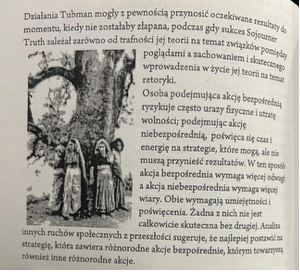
One of the first times that I recognized a familiar photograph in this collection of anarchafeminst and queer zines was a photograph of a group of women standing with their backs pressed firmly against a tree trunk. They were not embracing the tree but instead protecting it and others. My specific memory of this photograph came from attending high school in India and looking at photos from my old Political Science textbook.
This photo was from the Chipko Andolan movement, a non-violent ecological movement in India that gained prominence in the 1970s. It was one of the first well-known social movements in India to be led by women, where women from a village in Uttar Pradesh stood in front of trees in their forest, and refused to move for the loggers who had plans to fell over 2,000 trees that they depended on for survival (Chipko movement).
In the Polish zine, Matki z Kluczami Francuskimi (Mothers with French Wrenches), by Pattrice Jones, this image is used as an example of what environmental justice achieved through ecofeminism can look like, where the zine reads the Chipko Movement as anarchafeminist. Despite the infamy of the Chipko Movement within ecofeminist movements globally, I could not shake off my surprise at seeing this image of Tribal Indian women featured in a distinctly European context. This representation of Indian ecofeminism and social movements in India is something I had not encountered in other feminist and queer zines. This prompted me to question why this concept was foreign in the first place, and how place impacts our understanding of cultural materials, like zines.
Many, if not all, of the feminist and queer zines that I have read in the past have come from North America and/or European contexts. While these zines first introduced to zine culture, riot grrl activism, and taught me about important topics such as reproductive justice, workers’ rights, mutual aid and harm reduction, etc., the cultural contexts represented in these zines were distinctly made by and for White and otherwise ‘Western’ audiences. Despite zines acting as alternative outlets for non-normative writing and expression, diversity in race, class, and age is underrepresented in the zine community (Bold 2), leading to gaps in how diverse communities interact with zine culture. I argue that the absence of discourses involving ethnicity, race, culture, citizenship, location, etc., limits the potential impacts that feminist and queer zines could have.
Arguably, the absence of these discourses is caused by the pervasive nature of Eurocentrism. Eurocentric ideologies are positioned as so deep-seated that they continue exist even in more ‘progressive’ spaces, like zines spaces: many feminist and queer zines that feature images of white homogenous communities who are feminist and queer, while not including any representation and/or writings of Black, Indigenous, Brown and otherwise racialized transgender, feminist and queer communities. This repeated erasure of racialized voices from zines points to the systematic problem that Eurocentrism represents.
However, I argue that the anarchafeminist and queer zine collection from Poland successfully resists perpetuating these eurocentric ideologies, despite being produced in a Polish/European context. Although these zines were aimed at providing context to the post-Soviet era of Poland post-1989 and not directly involved with issues of racialization and colonization, this collection was able to provide space for the existence of global anarchafeminist discourses to be complementary and vital to the growth of anarchafeminism in Poland. Writings and visual representations in these zines accomplish this by writers acknowledging their privileges as White Europeans while learning and making meaningful reflections from global resistance movements and respectfully integrating them into their localized contexts.
For example, in the zine Chaos Girl #4, we learn about the Phoolan Devi Kollektiv, which is a “feminist, hc (hardcore) grrl collective” from Austria. Their name comes from Phoolan Devi, a female activist from a lower-caste background in India who experienced various forms of patriarchal violence, sexual assault and caste-related violence throughout her lifetime. When the collective was asked why they named it after Phoolan Devi, they explained:
Although we are all wimmin who derive from so-called western culture we purposely chose a womyn from a totally different background due to the fact that we do not want to present an eurocentric point of view. We want to pay credit to a womyn who fought for her rights under very dangerous circumstances.
(Chaos Grrlz 4)
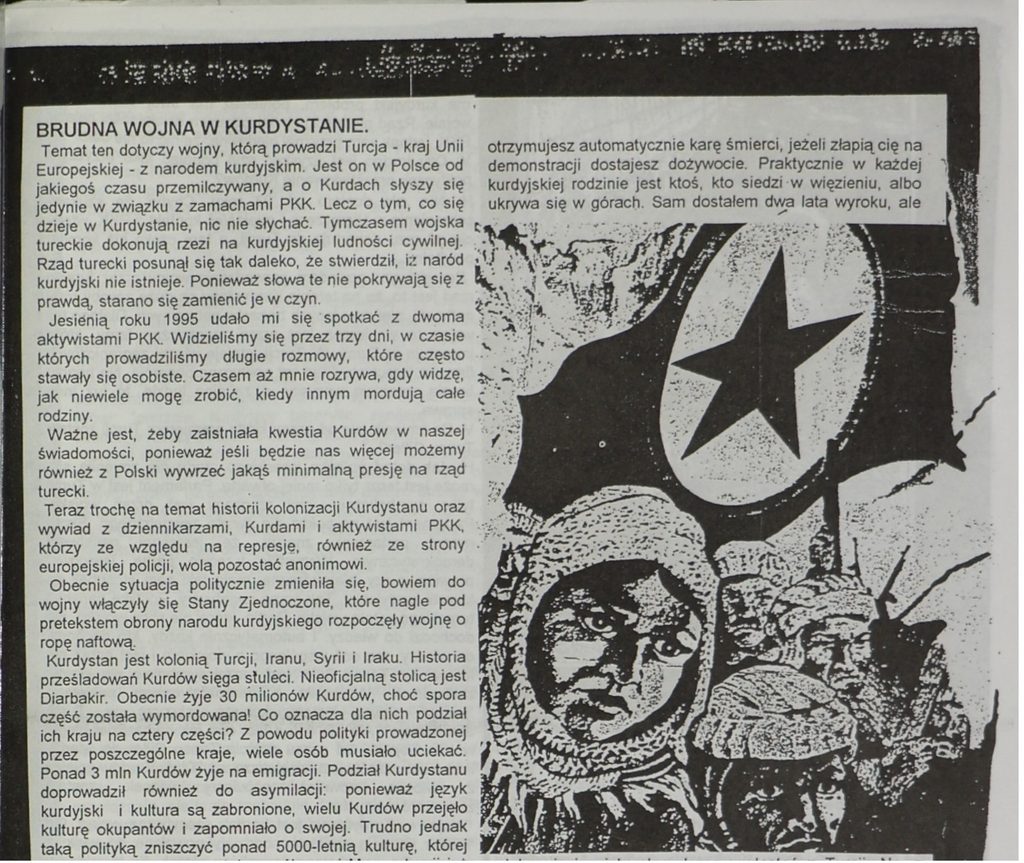
Other examples found in the collection include writings about Kurdish and Iraqi solidarity, pictures and writings about the lives of Vietnamese women, writings about Iranian graphic novel Persepolis, and as mentioned before, the Chipko ecofeminist movement, etc. By connecting the histories of women and racialized communities from different places to the lived realities of feminist and queer communities in Poland, they were able to set up solidarity globally. This inclusion of global perspectives was also aligned with the initial origins of anarchafeminism in Poland as well: which had deeper ties with alter-global circles in Europe like Radical Anti-Fascist Action and Youth Against Racism in Europe than with homegrown movements such as Anarchist Federation (Dynda), which they believed to be more patriarchal. This allowed them to express their understandings of anarchafeminism to include eliminations of all oppressive forces (racial injustice, imperialism, colonization), even if they are not directly connected to Poland’s own struggles.
Recognizing the different flows of ideas, things and people from differing cultures within this collection of anarchafeminist and queer zines shows how place-based research methodologies work as a necessary tool to understand how anarchafeminism shapes and influences these flows. I argue that unlike other neoliberal theories aimed at social reform and activism that is Eurocentric in nature, place-based research provides evidence that anarchafeminism is a social theory that can consider a wide range of factors (gender, race, class, ethnicity, culture, disability, age, etc.) in order to understand how and why oppressive systems form, and work towards ending them, accordingly. Therefore, anarchafeminist theory can be seen as fluid and can flow from place to place to generate valuable outputs and frameworks for feminist and queer political organizing, whether that is in Poland, in the Okanagan, or one of the many other places and regions mentioned in these zines.
To experiment with the idea that anarchafeminism and queer theory can generate productive outputs as a form of research, I will write and publish a fourth blog post about the public research event that I hosted on UBC Okanagan’s campus that displayed both physical and digital copies of these zines, featured a public talk about this research and had a zine-making workshop. By applying principles that I have mentioned in the previous blog posts, looking back at conversations that I had with participants during the event, and the zines created, I hope to engage with anarchafeminism in relation to place (being in the Okanagan) and the other places brought to the table through conversation.
Works Cited
Chipko Movement | History, Causes, Leaders, Outcomes, & Facts | Britannica. https://www.britannica.com/topic/Chipko-movement.
Culture, Widok Theories and Practices of Visual. “Visuality of Reproductive Rights in Polish Feminist Zines.” Widok. Theories and Practices of Visual Culture, https://www.pismowidok.org/en/archive/2022/32-reproduction-tracks/visuality-of-reproductive-rights-in-polish-feminist-zines.
Why Diverse Zines Matter: A Case Study of the People of Color Zines Project | Publishing Research Quarterly | Springer Nature Link. https://link.springer.com/article/10.1007/s12109-017-9533-4.