
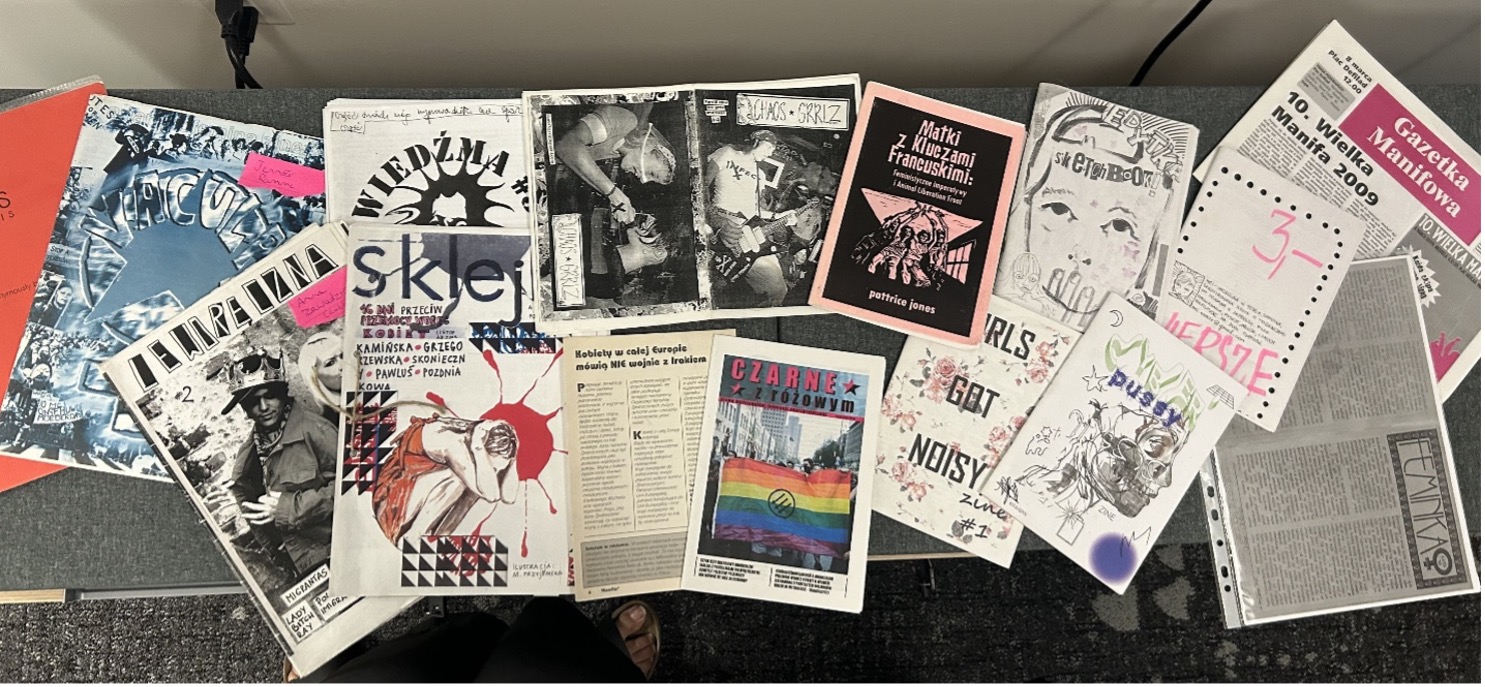
In my first blog post, I discussed the context from which this project, and my research, emerge. However, I have not yet tackled how the “anarchafeminist” content of these zines, provides specific insight into my research topic. While anarchafeminism is not a new theory within anarchism or feminism, it is still important to ask what definitions of anarchafeminism are relevant to this project’s objectives.
Anarchist writer and activist Emma Goldman, who is also known for her writing on women’s rights, defined anarchism as “the liberation of the human mind from the dominion of religion; the liberation of the human body from the dominion of property; liberation from the shackles and restraint of government” (Anarchism: What It Really Stands For). Peggy Kornegger, who credited Goldman as her introduction to anarchism, defined it using three major principles, which she also believed was related to anarchafeminism. These principles were belief in the abolition of authority, hierarchy, government, belief in both individuality and collectivity, and belief in both spontaneity and organization (Star et al. 31-32).
From here, theorists developed diverse articulations of anarchafeminism. Bottici defined anarchafeminism as “an understanding of women’s liberation not on the basis of a single factor but rather based on the multi-faceted ways in which multiple factors, converge to foster patriarchy” (3). This anarchafeminist framework is not entirely foreign, as it is similar to intersectionality, which is a “lens through which to view race, class, gender, sexuality, etc., as mutually constituting processes that do not exist independently from each other” (Star et al. 47).
To put it plainly, anarchafeminism is a form of anarchism that wishes for liberation from all dominant hierarchal forces and institutions, including heteropatriarchy and heteronormativity that shape women’s and queer people’s lives in restrictive and harmful ways. Anarchism and anarchafeminism believe that it is impossible to eradicate exploitation while class society (and other institutionalized hierarchies) still exists (Star et al. 48).
For instance, anarchafeminism would not see legalizing abortion as the sole answer to reproductive freedom. Instead, anarchafeminism would ask whether individuals were able to have and support children, have access to health care, housing, education, and transportation (Star et al. 51). Anarchafeminism questions the world that all people live in, thereby refusing to “centralize any structure or institution over another, except by context” (52).
In that same vein, I am interested in how “context” has the potential to extend anarchafeminism to different places and spaces. As Rogue and Volcano put it, structures and institutions operate to (re)produce one another, meaning that the circumstances that require the deployment of anarchafeminism exist in more than one place. Therefore, anarchafeminism exists in relation to different contexts and places globally. An understanding of this collection of anarchafeminist and queer zines outside of their original contexts, can reveal how anarchafeminism and place shape each other respectively.
This relationality is a key reason why I decided to employ a place-based research methodology for this project. Feminist geographer Doreen Massey says that place is not just static and geographical, but also “made by the flow of people, things, and ideas coming from other parts of the world, and by multiple relations among these elements” (Place-based methodologies). Similarly, anarchafeminism is theorized into existence from the flow of writing, people, conversations, and the experiences of women and queer communities under the dominion of institutions. Therefore, we can consider anarchafeminism to be something, (an idea maybe?) coming from another part of the world that can gain meaning and value by being brought to the Okanagan through this zine collection.

When I first looked through the zine collection, I felt very overwhelmed. Although I spent time reading and researching widely to prepare for this project, I was not sure how to approach it now that the zines were physically in Kelowna. To start with, the zines in the collection were unlike a majority of the zines that I had seen or made before. My knowledge about zines was limited to what I had seen in Canada so far, which were booklet sized and short in length. I spent hours looking through these zines, alternating between using Google Translate (as most of these zines were in Polish) and using visual cues to parse out meaning behind these zines. Through continually returning to these zines, reading various sources on post-socialist Poland, and talking to Dr. Dynda, who collected these zines, I was able to begin to shift my focus from the translation of each individual zine, and instead focused on its value as a collection.
Dr. Dynda urged me to look at the collection as a whole, noting the differences between Polish and North American zine culture: “I have noticed that there is a unique divide between how zines are produced [in both places]. Poland’s zine culture is very collectivistic and is meant to deliver a particular message. Some North American zines are also like that, but they are also very individual, and they are not always used as political or feminist organizing tools” (Dynda).
Keeping this collectivist ideal in mind, I began to look at these zines not as localized or individual, but rather as a collective response to the ideologically misogynistic and queerphobic policies enacted in post-socialist Poland. For anarchafeminist and queer communities who existed under this harmful rhetoric, zine-making became a space for them to express their reactions to these circumstances, and form stronger communities with each other, built on cooperation and solidarity. Therefore, I believe that these zines can showcase how anarchafeminist politics continues to exist in post-socialist Poland and the value of understanding and engaging with anarchafeminist ideas.
For the ease of my research, I chose 15 zines from the original collection to act as representative of the collection as a whole, choosing zines from both anarchafeminist collectives (Wiedzma, Chaos Grrl, Vacula, etc.) as well as miscellaneous ones (Girls Get Noisy, Czarne z różowym, Queers Read This, etc.) I also decided to categorize these zines into distinct yet overlapping categories to show the political, socio-cultural, and embodied expressions in the zines.
Many of these “zines” served a specific political action. I say zines in quotes here, because many materials here do not look like zines that I have come to associate with the term, like pamphlets, flyers, stray pieces of paper, etc. One of these materials that caught my eye looked like a newspaper and was entitled, “Gazetka Manifowa”. This zine was from 2009 and encouraged people to join in the Great Manifa, which was a feminist and queer demonstration occurring on International Women’s Day, and march for women’s rights.
These types of materials were made and distributed to encourage political mobilization and was a common strategy to connect possible anarchafeminists with other like-minded people. Even small pieces of paper were used for this political organization, displaying that this grassroots political organization was characteristic to anarchafeminist politics in Poland.
Other zines in this collection (Chaos Grrl, Łechtaczka, etc.), depicted what the social and cultural lives of anarchafeminists were in post-socialist Poland. These zines were reminiscent of what Riot Grrl punk subculture in North America seemed to be like. There were many interviews with punk and hardcore bands, often female-led, if not all female, in celebration of being punk in relation to women’s rights and freedom. However, these zines also gave emphasis to the political situation of Poland, and the culture in which this punk resistance was taking place.
Edition #4 of Chaos Grrl, for example, had many intervals in between their interviews with punk/hardcore bands to talk about female organizational solidarity in Poland, veganism as feminist practice, and other informal interviews about what it meant for people organizing to be anarchafeminist, along participating in punk, as a radical response.
This enmeshment of anarchafeminism with punk sub-culture, depictions of self-expression, and the political circumstances of Poland illustrated what anarchafeminist politics look like in action. It was personally interesting to see punk, something viewed as male-dominated in the public sphere, was filled with not only women, but queer, anarchafeminist women. I would argue that this lives with the definition of anarchafeminism: resisting against all forms of domination and hierarchy, in the public, personal and cultural.
It is from this resistance that I noticed another characteristic aspect of these zines, which was its honest and explicit depictions of women’s and queer people’s bodies. Although there are specific zines that made me point to this (Edytka Sketchbook), these visual representations appear in multiple zines in the collection. From striking illustrations on the front page, designed to catch attention, to free-hand sketches, doodling and designs within the zines, these designs depicted bodies in direct opposition to how gender was supposed to be constructed under Poland’s governance, post 1989. It directly challenged the conservative construction of gender that Poland’s governance in the post-socialist period had pushed for, casting women to be mothers and carers under the moral influence of the Catholic Church.


Instead, as part of anarchafeminist politics, and resisting this institutional framing of women’s and queer people’s bodies and lives, these zines can invite people to engage with an embodied and politically informed relationship to gender, not only something that is being legislated against, but also as something that can be constructed to be demonizing or liberating, depending on which form you embody.
I argue that this collection of zines, when read together, sheds a light onto what resistance and liberation under anarchafeminist politics can look like. Although anarchism has often been associated with chaos, the exploration of how women and queer people have continued to exist, resist, and build alongside one another, shows that this form of political, socio-cultural and embodied resistance is possible. In my next blog post, I would be interested in looking at how these resistances were globalized at the time and can continue to do today in the Okanagan and other regions of the world.
Works Cited
Bottici, Chiara. Anarchafeminism. Bloomsbury, 2021.
Dynda, Barbara. Personal Meeting. Soha Aftab. 3 July. 2026.
Goldman, Emma. Anarchism: What It Really Stands For. Goldman Reference Archives, 1910. Accessed 22 August 2026. https://www.marxists.org/reference/archive/goldman/works/1910s/anarchism.htm
Crosby, Alexandra and Ilaria Vanni. “Place-Based Methodologies in Transdisciplinary Research.” Integration and Implementation Insights, 28 Mar. 2022, https://i2insights.org/2022/03/29/place-based-methodologies/.
Star, Dark, et al. Quiet Rumours: An Anarcha-Feminist Reader. pp. 1–149.